UV-C Coil Cleaning: Why Manual Cleaning is Costing You Money
November 5, 2026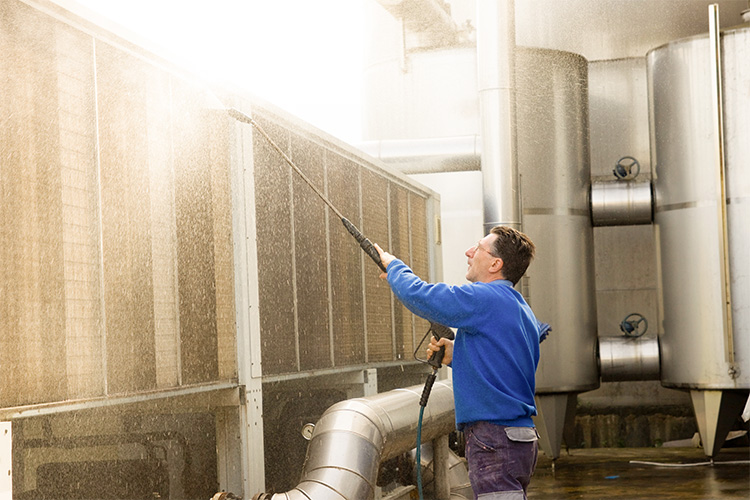
The Biofilm Problem
Your evaporator coil is growing a living organism right now.
Biofilm doesn't wait for your cleaning schedule. It starts forming within days of the coil being installed, especially in humid climates. It grows continuously on the surface and deep within the coil structure where you can't see it. It's a thin layer of bacteria, mold and organic material that looks invisible from the outside but dramatically reduces your system's efficiency.
When biofilm coats an evaporator coil, the system has to work 15–30% harder to move the same amount of air and achieve the same cooling effect. That's a direct hit to your energy bill. And unlike a sudden compressor failure that triggers an emergency call, this inefficiency just keeps compounding month after month, year after year.
Most facility managers don't even know this is happening. A coil looks clean on the surface, so people assume it's clean. But the real problem is inside the coil structure, in the micro-spaces between the fins where biofilm establishes itself and keeps growing.
Why Manual Cleaning Fails
Manual cleaning addresses the symptom, not the problem.
When a technician cleans your coil, they remove visible biofilm from the surface. They hit the front of the coil hard and try to reach back, but they can't fully access the interior fins where biofilm also lives. Result: You get a temporarily cleaner coil, but the biofilm never fully goes away.
Within days, it starts rebuilding. Within weeks, it's back to slowing your system down. So you schedule another cleaning. The technician comes back, you pay another service call and the cycle repeats.
You're paying for this repeatedly. Every cleaning cycle. Forever. And the problem never actually goes away because you're not eliminating the biofilm: You're just interrupting it temporarily.
The facility manager at one of EMC's portfolio clients described it directly: "We were paying for cleaning every month, our energy costs weren't improving, and we'd never solved the actual problem. We were just managing the symptom."
How UV-C Stops the Cycle
UV-C technology doesn't wait for a technician or a cleaning schedule. It works continuously, 24/7, and it solves the problem at the source.
UV-C lamps are installed inside your HVAC system, positioned to irradiate both the front and back surfaces of the evaporator coil. When the system runs, UV-C light continuously destroys biofilm as it forms, preventing accumulation from ever reaching problematic levels.
The biofilm can't build up if it's being actively destroyed. The coil stays clean. The system runs at full efficiency. Energy consumption drops. And the cleaning process never stops when the technician leaves because it's built into your system.
The Efficiency Gain
Energy costs drop by up to 20% when UV-C coil cleaning is installed on systems where biofilm has been accumulating.
That's not speculation. That's the measured result from systems that have had UV-C retrofitted and had their energy consumption tracked before and after installation.
Here's a concrete example: One national retailer installed UV-C coil cleaning across its HVAC systems. At a single location, they cut HVAC energy consumption by 86,000 kWh in the first year after installation. That's not total building energy reduction. That's just HVAC. That's what one piece of technology did for one building.
The real impact shows up in the ROI calculation.
The Financial Case
Here's what the numbers look like on a typical commercial building.
A 30,000-square-foot building running standard HVAC might spend $12,000–15,000 annually on HVAC energy. A 20% reduction through UV-C saves $2,400–3,000 per year.
UV-C installation typically runs $3,000–5,000 per unit, depending on system configuration. One client saved $9,500 in year one, a payback under 12 months.
More commonly, payback occurs within 2–3 years. After that, you're running with lower ongoing operating costs indefinitely. And you're eliminating the recurring manual cleaning cycles that were costing you money every month.
The math changes further at portfolio scale. A 30-building portfolio with 60 HVAC units represents a $180,000–300,000 capital investment in UV-C, but it also represents $144,000–180,000 in annual energy savings. That's a portfolio-wide payback of 1.5–2 years, after which your entire portfolio runs more efficiently.
Why This Matters Beyond Energy Savings
Lower energy consumption isn't the only benefit, though it's the most easily measured.
A coil that's not being smothered in biofilm also transfers heat more effectively. Your system reaches setpoint faster. Temperature consistency improves, which means tenants are more comfortable and your facilities team deals with fewer temperature complaints.
A cleaner coil also means less moisture accumulation and less microbial growth, which improves indoor air quality. For portfolio owners dealing with tenant complaints about indoor air, or for healthcare or education facilities where air quality is critical, this is a significant benefit.
And a system that isn't working 15–30% harder to overcome biofilm accumulation also experiences less wear. Components last longer. The system stays more reliable. You're not dealing with unexpected failures caused by biofilm overload.
The Retrofit vs. New Build Question
UV-C can be retrofitted into existing HVAC systems, which matters because most facility managers aren't replacing all their equipment next month.
EMC handles UV-C retrofits across entire portfolios using our EnergyMAXX® process, which manages every project from initial audit through installation at every location. That's not one technician installing systems inconsistently across your sites. That's a coordinated deployment with standardized installation and performance tracking.
You get the benefit of continuous coil cleaning across your entire portfolio without replacing functional equipment.
Getting Started
If your energy audit shows biofilm accumulation, your manual cleaning cycles aren't improving performance or your HVAC energy costs are running higher than they should, UV-C is worth a serious look.
EMC audits your systems, identifies accumulation, estimates savings and calculates payback timelines specific to your buildings and local energy rates. You get the data. You make the call.
Not sure whether biofilm is an issue? EMC's 10-point RTU inspection identifies it as part of the standard process. Start there.
Contact EMC to set up a portfolio audit. We'll show you what's actually happening and what fixing it is worth.